
Check how far the screw enters the housing. Then show the full-thread depth and the room available for drilling.
A screw can feel tight while the cover still moves. That can happen when the tip meets the bottom of the hole before the head presses against the cover. On a compact hydraulic housing, drilling deeper may leave too little metal above a nearby oil passage. Check how far the screw needs to go before changing the hole.[1]
For a socket-head screw, the part that enters the hole is its under-head length minus the distance from the seated head’s underside to the housing face. A washer or a recess in the cover changes that distance.
Check the longest screw and thinnest cover stack first. Include the incomplete threads near the bottom in the check. A screw can bind there even when there is room between its tip and the drill point.[1]
Use the shortest screw and thickest stack to check engagement, the length over which the screw and hole threads overlap. If the screw has a plain shank, check where its full threads start. The designer sets the minimum engagement for the load and the materials. If a shorter standard screw still meets it, you may be able to keep the housing as drawn.[2]
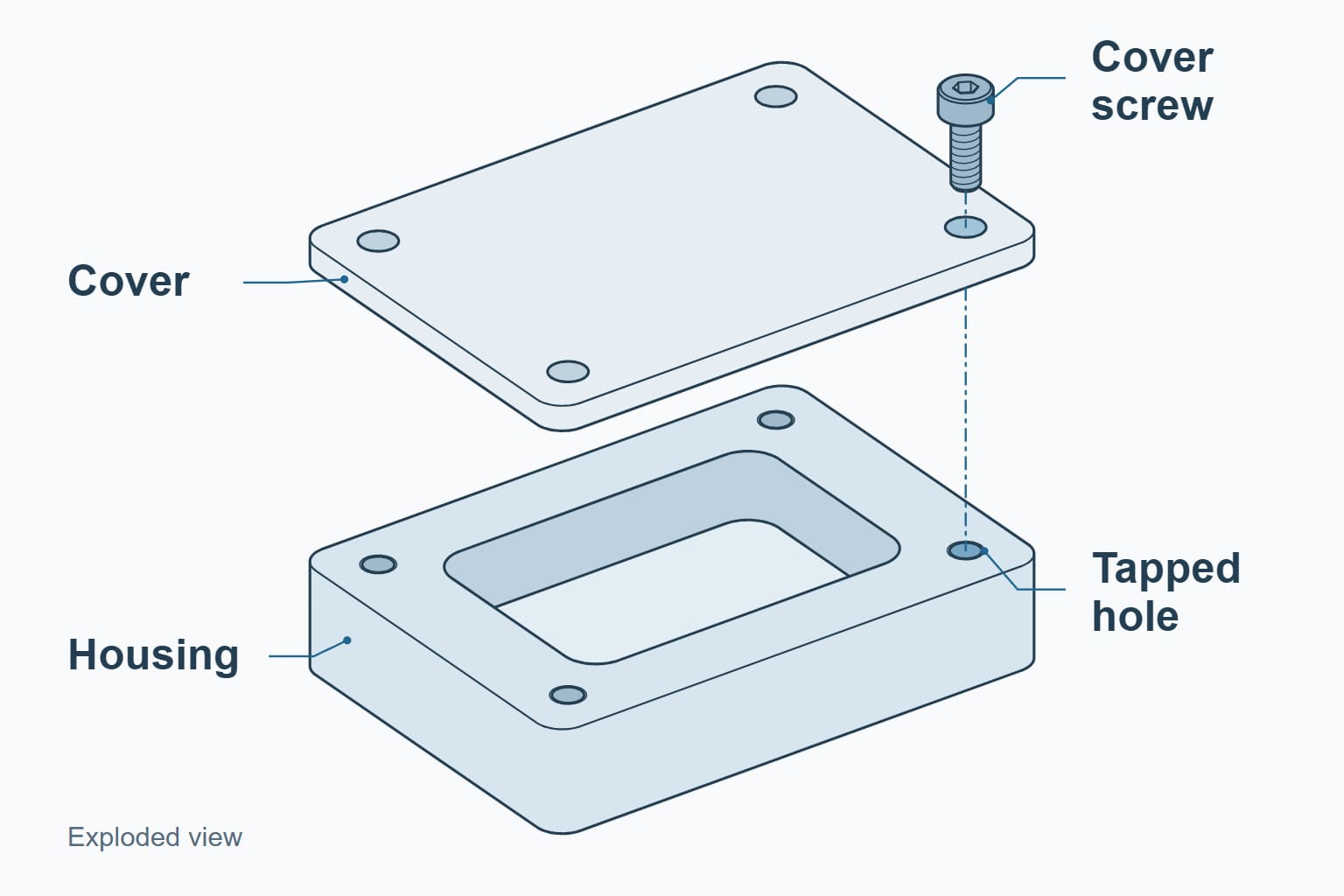
The cover screw passes through a clearance hole in the cover and engages the tapped hole in the housing. Exploded technical illustration.
A change to the cover can cause the same problem. If a recess puts the head a millimetre closer to the housing, the screw reaches a millimetre farther into the hole. That can matter even when its part number stays the same. Recheck the projection when the cover thickness, recess or washer changes.
Give the thread size, pitch and tolerance class, along with the minimum length of full thread and the face used to locate it. The entry chamfer takes up some of the space at the mouth. A tap has a tapered lead at its tip, which leaves incomplete threads near the bottom. A conventional twist drill also leaves a conical point below the full-diameter part of the drilled hole.[3]
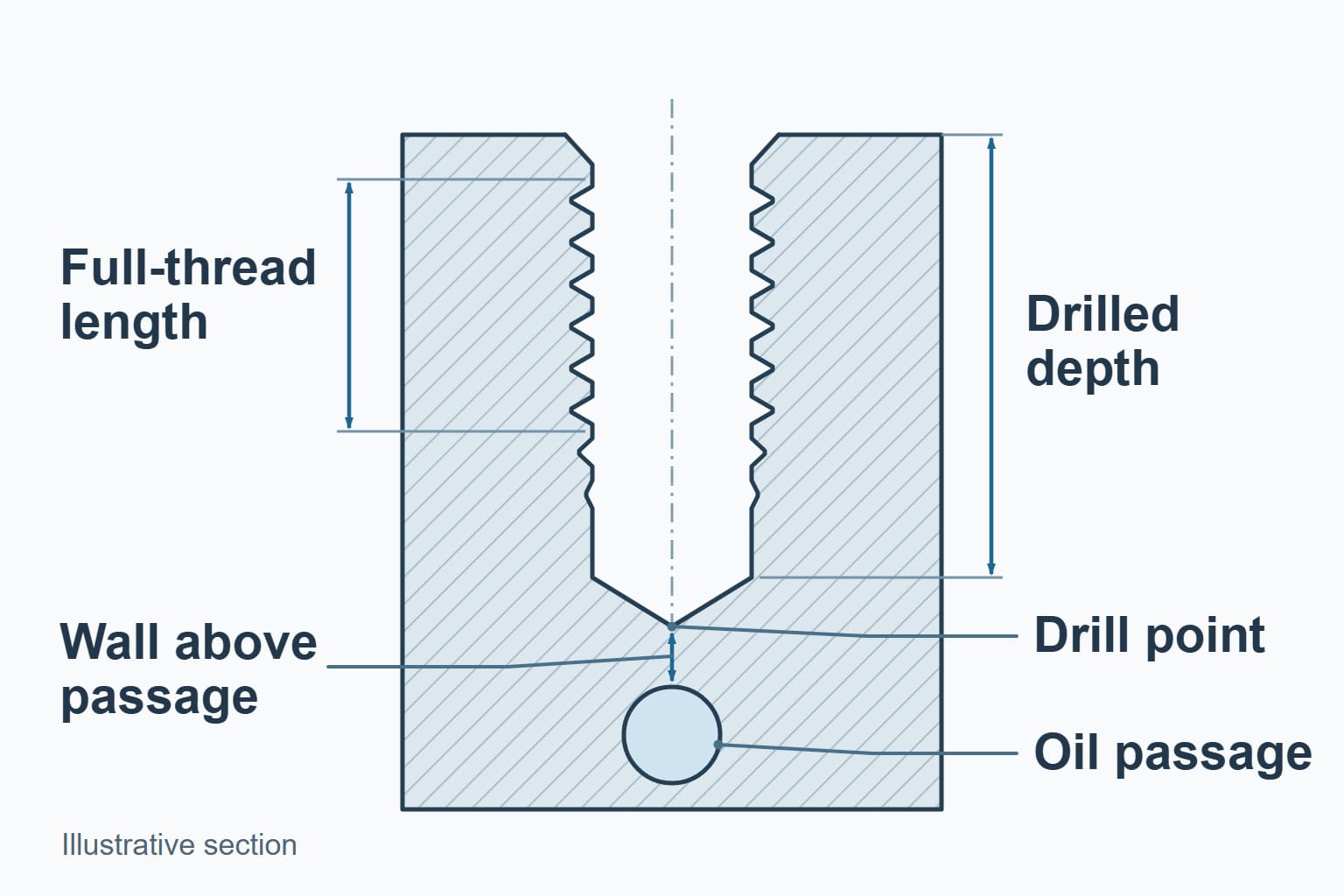
The drilled depth in this section ends at full diameter. The drill point extends below it, leaving a wall above the oil passage. Technical illustration.
If an oil passage runs close to the hole, add a section through the two features. Say where the drill-depth dimension ends. If you measure to the end of the full-diameter portion, show how far the drill point may extend or specify the minimum wall to the passage. Include the passage position when checking that wall. Its distance from the hole can change as either feature varies within tolerance.
A spiral-flute cutting tap can carry chips back towards the opening. A forming tap displaces metal and requires a suitable material and a hole sized for forming. Ask what the proposed tool needs below the last full thread. On 5 November 2026, OSG released its ZERO-GT forming tap, which it describes as having a short lead that brings threads closer to the bottom of the drilled hole.[4][5]
KingTeam can quote the drilling and threading with the rest of the CNC-milled housing. A section through the hole and nearby passage lets us check whether the required threads and the proposed drill depth fit in the space available. Tell us if the flange can be thicker around the hole. That change may make room for a standard tool.
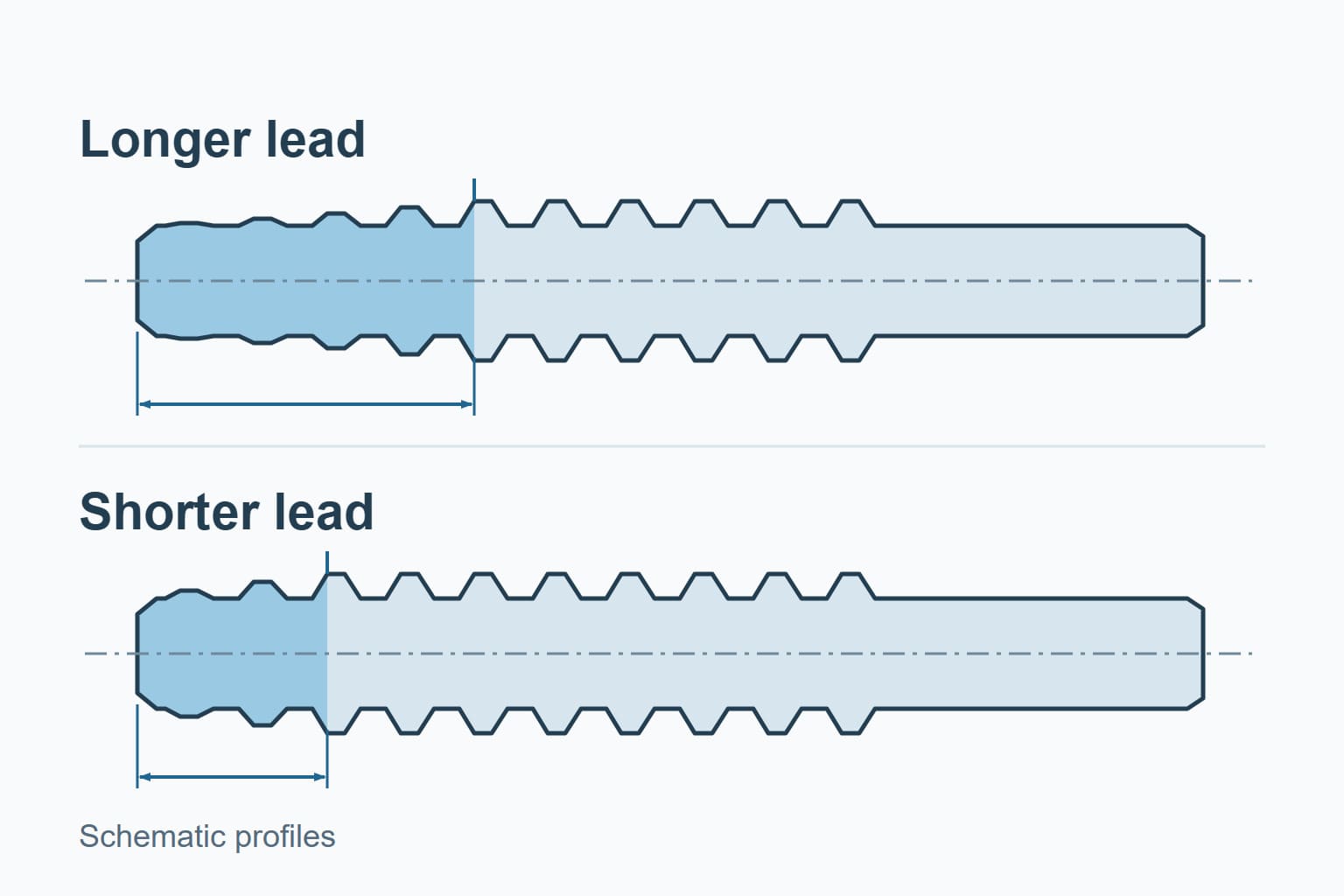
The shaded bands show two tap lead lengths. A shorter lead puts the first full-profile tooth nearer the tip. Technical illustration.
Send the housing drawing and the screw specification together. If one quotation includes an extra operation, ask what it achieves at the hole bottom and whether the price covers the specified full-thread depth. This is worth settling while there is still time to change the screw or the housing.
Agree how the supplier will report thread fit and usable depth. If the oil passage limits how far the drill can go, include the maximum drill-point depth or the minimum remaining wall in the inspection requirements. Settle how it will be checked before releasing the order.
Send your drawing, material specification, surface treatment, critical tolerances and expected volumes. Include a section through the hole if the bottom is close to a passage. We can discuss the machining and inspection requirements and quote the part.
 RETURN_LIST